


Many University of Florida students are familiar with the hiking trails at Payne’s Prairie Preserve State Park. But another collection of trails through a beautiful forest of tall live oaks and longleaf pines can be found not far south of Gainesville, and it’s free and easier to reach from I-75. Barr Hammock Preserve is definitely worth a visit if you’re looking for a quiet place to hike or bike while visiting Gainesville.
Barr Hammock Preserve sits on 12,000 acres of forested land previously used for cattle grazing south of Payne’s Prairie and just west of Micanopy. Acquired by Alachua County beginning in 2006 using Alachua County Forever land conservation funds, Barr Hammock has grown in the years since and is split into two sections with separate trail heads—a more open prairie section to the north with a single 6.8-mile loop, and a more forested southern section with four connected multi-use loop trails ranging in length from 3 to 9 miles. As Alachua County’s largest county-owned wilderness preserve, Barr Hammock provides a key wildlife corridor connecting Payne’s Prairie State Preserve to the Ocala National Forest.

On my way home from a football weekend recently, I stopped by Barr Hammock’s southern section and hiked the orange-blazed 8-mile Hammock Loop Trail. With most of its length shared with horseback riders, these trails are ideal for family hiking, as they combine easily navigated signage and blazes with sturdy hiking surfaces that are well-shaded. Although the preserve contains precious few narrow hiking-only trails, the wider forest roads are either grassy or reinforced in lower areas with limestone, which fortifies soft sand that might otherwise be hard on the legs and ankles.
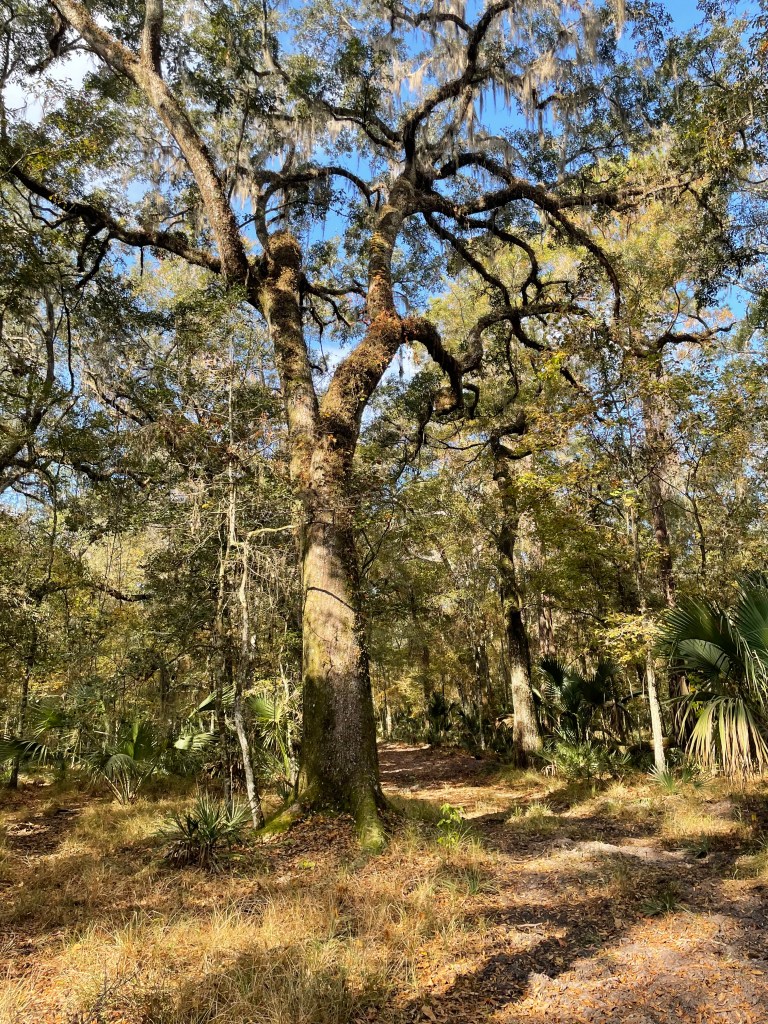
And whether wide or narrow, the trails meander through beautiful forests in varying ecosystems with large old growth trees. The beginning sections nearer the trailhead, many of which skirt residential properties, wind primarily through pine forest, with towering longleaf pines standing sentinel beside the trail. Then deeper into the Hammock Loop in its northwestern sections, the live oaks take over, with many tall, wide old growth live oaks draped with moss arching over the trail.

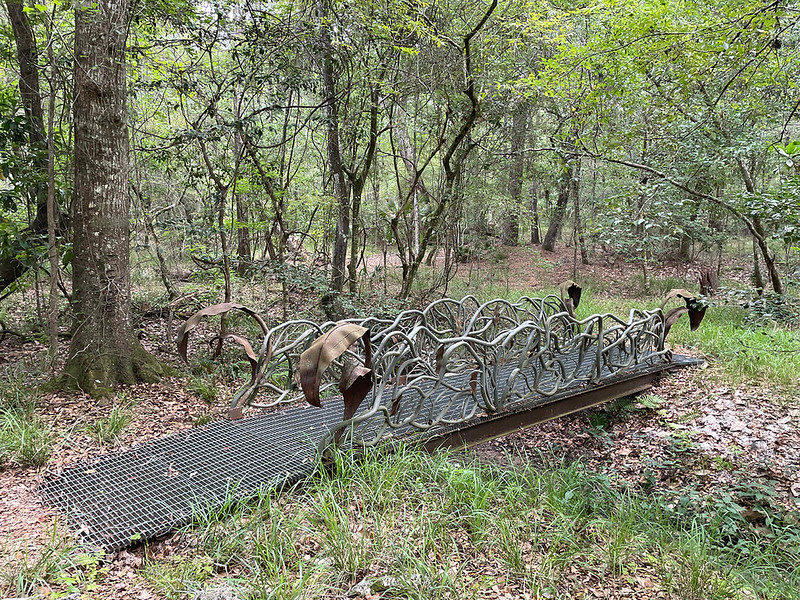
A particular treat and a great place to rest for a snack is the scenic overlook of Ledwith Lake about 3 ½ miles from the trailhead and parking area. This huge open space is presided over by a giant live oak and has a covered picnic table near the lakeside. The views here across Ledwith Lake and Prairie are vast and natural. Another artistic treat for hikers several miles northeast can be found at the steel bridge crossing Still Branch Creek that connects the Still Branch and Bayhead Trails, which is adorned with siderails twisted like vines.
Sections of the trail in lower lying areas can be flooded during wetter months, when mosquitoes may require insect repellant. Although none of the Hammock Loop was flooded when I visited, some short sugar sand trail sections were heavily rooted by hogs and took some huffing to get through. The area also teems with deer and hogs (I arrived late in the morning and saw only one deer), and alligators are common in the more open prairie portions of the loop in the northern section of Barr Hammock. The trails there are also popular with the equestrian set, so you’ll probably have to share the trail with friendly horses. But for a taste of easily navigated old Florida forest, Barr Hammock Preserve is a stop that should be seen if you have a few hours while visiting Gainesville.

Discover more from Central Florida Backpacking Desk Jockey
Subscribe to get the latest posts sent to your email.
