


Perhaps the most creative adaptations new backpackers learn to make are culinary. Regardless of what you like to eat or cook at home, your choices change when you have to carry your kitchen and pantry on your back. Although camping brings to mind visions of s’mores and roasting hot dogs over an open fire, the reality of backcountry dining is much different when consideration must be given to weight, fire-sopping humidity, exhaustion, impatient hunger, and the need to protect food from rodents and bears. But that doesn’t mean dining on the trail is not enjoyable.

Below are tips about what I eat and how I prepare it on the trail. Before I begin, I must make one caveat: I am not a thru hiker, only a weekend backpacker. I’m rarely on the trail for more than two nights at a time, so I’m not as sensitive to cost, nor must I cope with difficulties of resupplying while far from grocery or backpacking stores without transportation. I will leave it to the long trekkers to advise those considering their first Appalachian Trail expedition; these tips are for those who, like me, enjoy backpacking one weekend at a time.
Cooking and Crockery: As much as I love cooking over a campfire (and it ain’t much), I suspect most backpackers leave cowboy cooking to parking lot campers. It can take a very long time to boil water over an open fire, and collecting firewood for even a low maintenance fire can be more chore than pleasure after hours spent carrying a backpack. So I cook with a collapsible camp stove that screws into an isobutane/propane fuel canister sold at backpacking stores, and I leave the fire for post-dinner relaxation. Small fuel cannisters can also be packed snuggly in a small cooking pot.

The camp stove I use (a Soto Amicus) is light and folds to the size of my thumb. Note that the fuel is not propane, but liquid isobutane mixed with propane—you do not want to carry propane in a backpack, as it is much less stable. A good, light camp stove can be found at stores like REI for less than $50, and I’ve had no problem finding camp fuel cannisters when traveling, even in Sweden.

As for cutlery and crockery, anything small and metal will work, as you’ll be eating your meals in the pot you cook in (unless you instead eat from the packages containing your food). Advancements in metallurgy have made ultralight titanium pots affordable. The set I purchased came with two pots, but I take only one on the trail, along with a small titanium coffee mug, so I can brew my coffee while I’m using the pot for breakfast. My lone utensil is a metal spork. Cleaning is a simple matter of licking the spork clean and scraping out and consuming all contents in pots used for more than boiling water, then perhaps giving them a wipe or two with the packaging the meals arrived in.
Dinner: I admit it, I buy those fancy camp dinners they sell at REI. I don’t care that they often cost more than $12 a pop. I love that you can boil water, pour it into a zip lock package, eat straight from the package, and then have nothing to clean afterward. As another fringe benefit, the sealable package makes a perfect bag for other garbage that fits in the smallest of bear bags. Truth be told, many brands taste great. I prefer Peak, and being a vegetable hater, my favorites are Chicken Pesto Pasta, Sweet Pork with Rice, and Beef Pasta Marinara.

For those disinclined to spend so much, anything light and dry works well when backpacking; uncooked meat or things that melt in a backpack when not refrigerated, not so much. When I improvised a backpacking trip in Sweden and had to shop at a grocery store where food labels were only in Swedish, I went with ramen-style noodles and small pre-cooked sausages. Pasta or rice are easy staples, as are foods that can be flavored with spices or powders. Say goodbye to butter unless you want to wear it and sleep in it.
Breakfast: REI also sells boil-in-a-bag breakfast delicacies, but I go with simpler fare: oatmeal. Prepackaged single servings of oatmeal in plenty of flavors can be found at any grocery store, and they are quick and easy to make in the morning and can be eaten cold if it’s raining. (Personally, I prefer to have trail mix instead if I can’t boil water for my oatmeal.) I also like supplementing my oatmeal with a few M&Ms and dried cranberries from my trail mix to add some gooey texture and extra sugar.

I also love to start my morning with instant coffee. Even at home, I prefer instant over fresh brewed. Most grocery stores also sell single-serve coffee packets, and I drink Death Wish on the trail. The box says it was invented to keep astronauts awake and has 300 milligrams of caffeine per hit. Maybe. I do know one cup makes me pack my tent a lot faster.
Lunch and Snacks: Full disclosure, I rarely have lunch on the trail if I’m only spending one night—mainly because I like to have a big meaty wrap waiting for me in a cooler when I get back to my car; I usually also have one right before I begin my adventure to stock calories. When I have had lunch on the trail, I’ve gone with simple cowboy food that doesn’t need to be cooked, as I’m usually having lunch in the middle of a hike and don’t want to cook anyway. That usually means beef jerky. Diana Helmuth (the author of How to Suffer Outside I recently raved about in another post) also notes that cheese sticks and other processed cheeses hold up surprisingly well in a backpack.
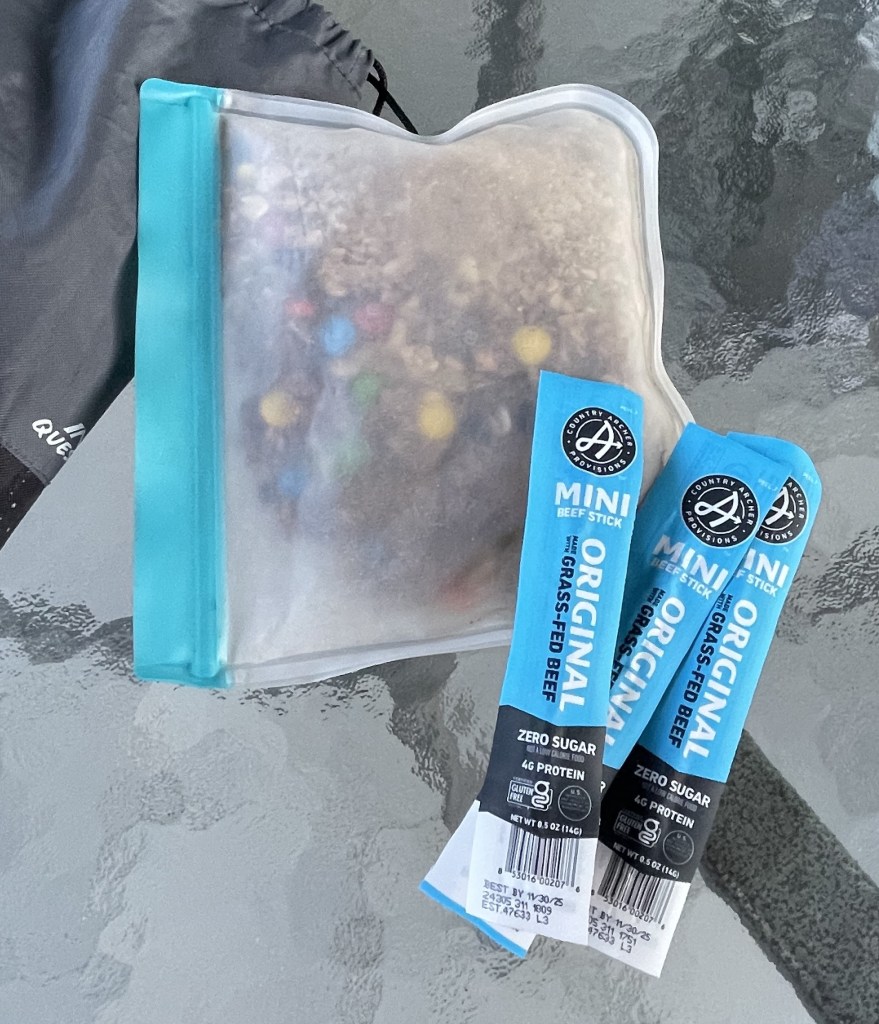
I also rely heavily on trail mix, which goes with me on every trip and is my all-purpose fuel. It can substitute for breakfast or even dinner if rain prevents cooking. It makes a great dessert after dinner. And when your brain begins fogging out during a grueling hike, it restores lucidity quickly. I make my own by mixing granola, M&Ms, dried cranberries, and cashews. I also always take more than I need in a resealable plastic pouch. If I ever get lost in the woods, I’ll survive by rationing my trail mix.
Water and Electrolytes: Water is the heaviest thing you carry on the trail, but it’s also the most indispensable, especially in Florida. Even for a trip lasting only one night, I take a minimum of 3 liters in a pair of 1.5-liter Nalgene bottles. If I anticipate more heat or longer distance, I also often strap an extra liter in a collapsable bottle to the outside of my pack, which can then be stowed when its contents are consumed.

I also carry a water filter. I suspect the thru hikers who know what they’re doing may question taking 4 liters of water for one night when you can supplement by filtering from water sources found on the trail. To that, I reply that water pumps can be notoriously dry, and I’ve heard a few too many stories about rising fecal content in rivers that many backpackers use as water sources. I camped in late February with a thru hiker doing the entire Florida Trail who carries twice as much water as I do for that reason, even though he was so touchy about weight that he chose to burn his second pair of underwear to lighten his load. So as a weekend warrior who dreads the thought of gastrointestinal complications without porcelain and extra double-ply, I bring what water I need.

I also take electrolyte tablets, which many backpackers use to cover the metallic taste of pump water. To avoid also flavoring my Nalgene bottles, I take a 12-ounce Gatorade with me on my hike in, then refill it with water and throw in a tab; sorry, landfills. I still have yet to find a flavor of electrolyte tab that suits my pallet, although Nuun’s grape flavor is growing on me. Adding electrolytes to water reduces cramping inside the tent and on the drive home, so I can tolerate a little aftertaste.
Discover more from Central Florida Backpacking Desk Jockey
Subscribe to get the latest posts sent to your email.
